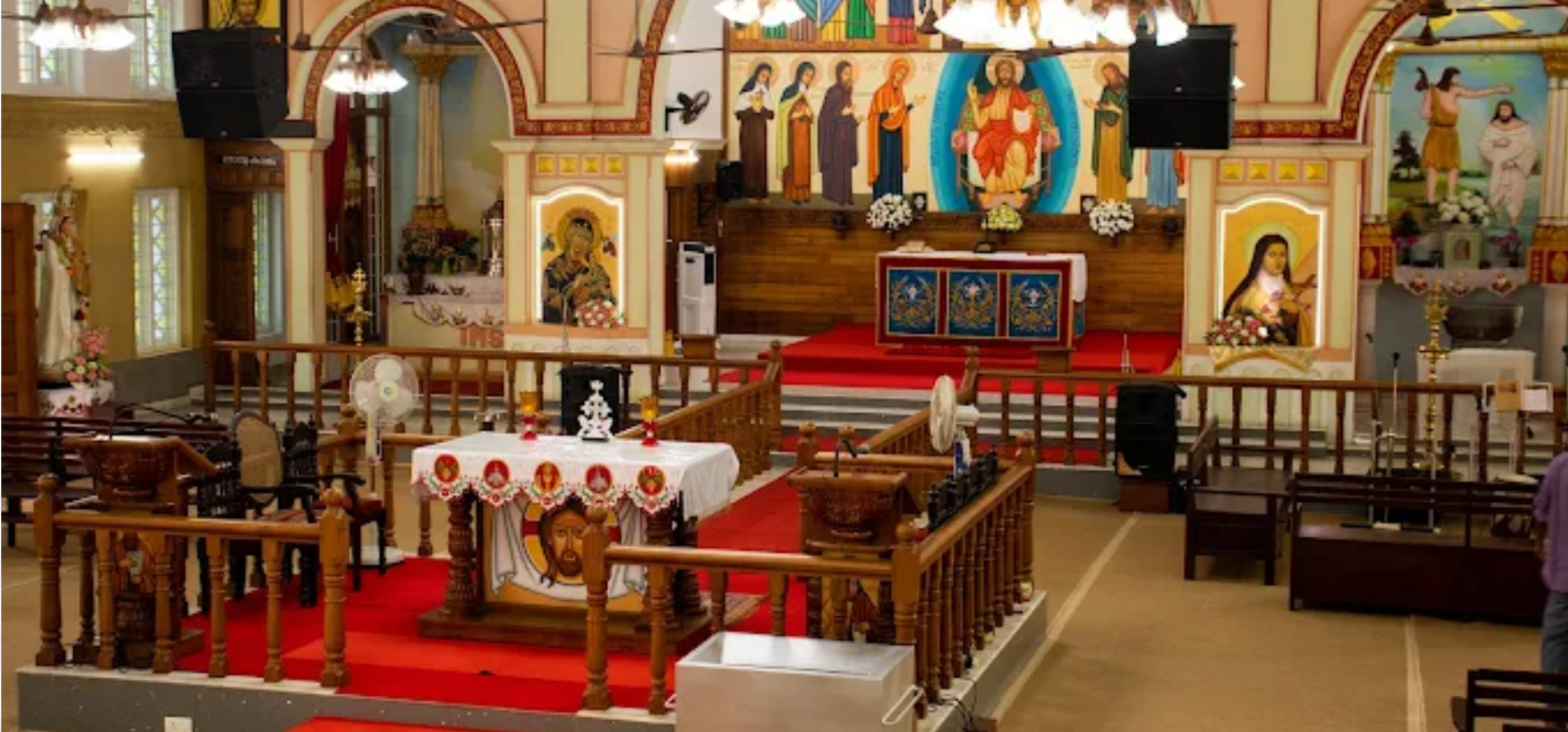
Spirituality as Pilgrimage: Symbolism in the East Syriac Liturgical Space
The Pilgrim Church
Spirituality is the pilgrimage towards Heaven, which is made by every believer as a response to the call of God. Every son and daughter of the Church is a pilgrim who journeys through this world seeking Heaven, ‘for we have no city which is permanent here; but we are seeking one that is to come.’ [Heb 13:14]
The Church sees herself as a ship travelling through a dangerous sea, aiming towards the harbour of eternal peace. The dangerous sea represents the attacks of the devil, and the harbour of eternal peace is Heaven.1 Our spirituality as members of the Church is participation in her pilgrimage toward Heaven in the liturgy.2
Liturgical Space
Proper celebration of the liturgy is enabled by the liturgical space; the church and the various areas within it. Mar Aprem teaches that the liturgical space makes Isho present in our space and time.3
An East Syriac Church is divided into three primary sections: the Qanke (sanctuary), the Qestroma and the Hykala (nave).
The Madbaha (altar) is situated within the Qanke, hence, the Qanke represents Heaven. The Madbaha is separated from the rest of the Qanke (sanctuary) by the inner veil, and the Qanke is separated from the rest of the church by the outer veil. These veils remind us that heavenly life is for the chosen people; only those who prepare themselves for Heaven here on earth are able to enter the Kingdom.
The Qestroma, situated between the Qanke and Hykala, is where the altar servers and choir stand, representing the angelic choirs. The Hykala is where the faithful stand, representing the world. Facing towards the Madbaha (altar) in the Hykala represents the spiritual orientation of the faithful towards Heaven.
The other prominent structures are the Beth Gazze (labelled BG), Sqaqona, Bema, Beth Mamodisa (baptistry), Beth M’shamshana (sacristy) and Beth Sahade (reliquary).
The pilgrim life of a Nazrani is shown in the liturgical space (from right to left): our Christian life begins at baptism at the Beth Mamodisa, then we are divinised by receiving the Holy Qurbana from the Madbaha during our earthly life, so that when we pass from this world, we will be counted among the Saints at the Beth Sahade.

Praying Toward the East ad orientem
Upon entering a church, we enter into the liturgical space, and we face East towards the Madbaha (altar). All East Syriac Churches are traditionally built facing East.4
Facing East symbolises our hope and preparation for the Second Coming of our Lord, ‘for as the lightning comes from the East and flashes as far as the West, so will be the coming of the Son of Man.’ [Mt 24:27] The Church Father Mar Basil teaches that in our spiritual pilgrimage, we are seeking Paradise, ‘which God planted in Eden in the East.’5
Pope Benedict XVI taught that turning toward the East during the liturgy is not about simply facing a wall, but that we look together with the priest ‘toward the Lord.’6
In East Syriac churches, the Mar Sliva is placed on the Eastern wall. The Body of Isho is not on the Mar Sliva, symbolising His Resurrection.4 The Mar Sliva is thereby the Risen Lord Himself, and Pope Benedict XVI taught that the Cross, the sign of the Son of Man, ‘announces the Lord’s Second Coming.’6
Facing the Mar Sliva in the liturgy represents our spiritual pilgrimage to the Kingdom of the Risen Lord, as well as His return from the East.
Sqaqona
The Sqaqona is a narrow pathway with railing which runs between the Qanke (sanctuary) and the Bema.
Since the Qanke represents Heaven, and the Bema represents the earthly Jerusalem, the Sqaqona represents the path between Heaven and earth.4
For our spiritual pilgrimage, this narrow pathway represents the holy and faithful life we must follow to go to Heaven after our earthly life.
To follow this narrow path, our eyes must always be oriented toward Heaven, rather than worldly gain.
‘How small is the gate, and narrow the way, that leads to salvation; and those who find it are few!’ [Mt 7:14]
Bema
The Bema is a raised platform with railing, situated in the centre of the Hykala (nave), and it is where the Liturgy of the Word is celebrated.
It is placed in the centre of the congregation because Isho came from Heaven and lived in the midst of the people, revealing and explaining the Word of God to them.4 Scripture reveals the intimacy of Isho towards the human race, as ‘the Word became flesh and dwelt among us.’ [Jn 1:15]
This mystery is revealed through both the entrance procession and Gospel procession of the East Syriac liturgy, as they begin at the Madbaha (Heaven) and culminate at the Bema in the midst of the congregation, because Isho came down from Heaven to seek and save us. [cf. Lk 19:10]
The placement of the Bema in the middle of the congregation reminds us that God is not distant, as He comes down to speak to us and to live with us in the liturgical celebration.7
Our spiritual pilgrimage, therefore, is not the search of lost souls to find a hidden God.
Rather, our pilgrimage is a response to the call of Isho who reveals Himself in the Holy Qurbana; in the Scriptures at the Bema, and in the broken Bread at the Madbaha. [cf. Lk 24:27-35]
“Fill us with Your grace and strengthen us, who have listened to the Holy Word, to take part in the mysteries of Your Pesaha and to be conformed unto You.”
Conclusion of the Karozutha, Gilyana d’ Maran - Feast of the Transfiguration of our Lord
Footnotes
-
Maniyattu P, East Syriac Theology: An Introduction (2007) ↩
-
Catechism of the Catholic Church, 1090 ↩
-
Toma W, Basic Features of the Liturgy… (2016) ↩
-
Pulluthuruthiyil AJ et al., Syro-Malabar Church Architecture and Traditions (2024) ↩ ↩2 ↩3 ↩4
-
Basil, De Spiritu Sancto 27 ↩
-
Catechism of the Catholic Church, 1088 ↩
Jeffrin Saju
Master of Ceremonies, St Alphonsa of the Immaculate Conception Cathedral
Syro-Malabar Eparchy of Great Britain