How to pray the LoTHs
As I noted in my article What are the Liturgy of The Hours?, The Liturgies of the Hours, “Yamaprathanakal” or Divine Praises are the heartbeat of the Syro-Malabar Church. They are tied to specific hours and to the rhythm of the liturgical calendar. It allows us to come together as a community, displaced as we are, to celebrate our day, give thanks to God and sanctify time itself. These Divine Praises allow us to transform our days into prayers to God. But praying them, especially if we are dependant on using online copies, can be difficult. As such, the following guide hopes to assist make that process smoother.
Reading of the Day
The Liturgical day starts with Ramsa (Evening Prayer) of the previous day. There are still remnants of this understanding of the day in celebrations of Christmas Eve, and similar times. That is to say Liturgical Sunday starts with “Saturday” ’s Ramsa. As such the readings for Ramsa and Lelya must also be from the following day. I would recommend using my free calendar download (bottom of the blog post on seasons of the church), scrolling down to the bottom of the Divine Praises Page, using SyroCalender’s daily reading selector or referencing the Syro-Malabar reading calendar / app (SyroMalabar Praarthanakal or SyroMalabar) to select the following day’s readings.
The Hours of the Day
Each Liturgy of the Hour has a set time prescribed by the church. For Ramsa that is around 6PM to 9PM, for Lelya that is before we sleep (9PM to 3AM), for Sapra that is when we wake up (6AM to 9AM). The church exhorts its people to pray these prayers at these set times (CCC 1174 - 1178).
Using the Online PDF
Ramsa
Before starting Ramsa, remember to exchange peace starting from the presider.
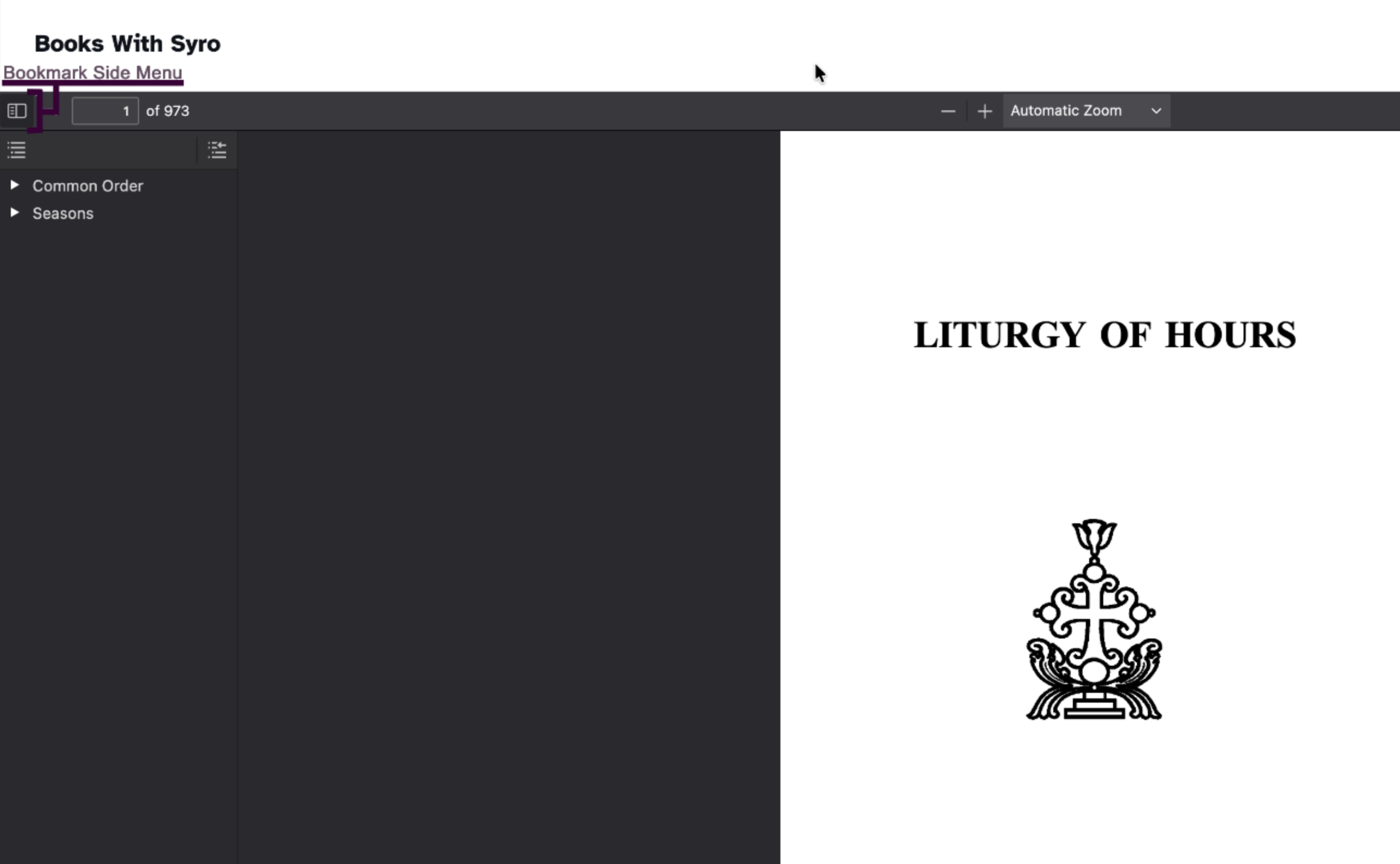
To start, click on the bookmark side menu and navigate to “Common Order” –> “Ramsa”. Follow this common order untill you reach the “Psalm (of the day)”, to find this psalm, click on the bookmark side menu, navigate to “Seasons” –> The current seaon –> The liturgical day –> Ramsa –> Click the # week of the season. The page references are hyperlinked to take you directly to the page.
During Ramsa we chant a single Psalm (specific to the day). The Deacon starts by chanting the first verse, followed by “Alleluia, Alleluia, Alleluia.” (During the Season of Great Fast, the Qanona is chanted instead of the Alleluias). The community sits and takes turns chanting the Psalm, starting from the first verse, this time without the Antiphon. At the end of the Psalm, the Deacon chants the doxology (Glory be to the Father, and to the Son, and to the Holy Spirit. From eternity and forever, Amen.), followed by the Antiphon, then “Let us pray. Peace be with us.” The congregation stands at the doxology.
To continue, click on the bookmark side menu and navigate to “Common Order” –> “Ramsa” –> “Psalm of the Day”. On Ferial days, the following prayer and Hymn of Incense is omitted.
At the Onitha daqdam (Hymn before the Psalm), with the Deacon initially starting, the congregation takes up the prayers as two sides. Naviagate to the correct seasonal day, once finished navigate back either using the hyperlink or click on the bookmark side menu and navigate to “Common Order” –> “Ramsa” –> “Onitha daqdam”
At the Onitha d’Wasar (Hymn after the Psalm), with the Deacon initially starting, the congregation takes up the prayers as two sides. Naviagate to the correct seasonal day, once finished navigate back either using the hyperlink or click on the bookmark side menu and navigate to “Common Order” –> “Ramsa” –> “Onitha d’Wasar”
Gospel of the Day can be found using the instructions detailed above in Reading of the Day
At the Onitha d’Ramsa/d’Wasaliqe (Evening Anthem), with the Deacon initially starting, the congregation takes up the prayers as two sides. Naviagate to the correct seasonal day. Note that for the Aswasa / Suraya, the Deacon starts by chanting the first verse, followed by “Alleluia, Alleluia, Alleluia.”. The community takes turns chanting the Psalm, starting from the first verse, this time without the Alleluias. At the end of the Psalm, the Deacon chants the doxology (Glory be to the Father, and to the Son, and to the Holy Spirit. From eternity and forever, Amen.), followed by the Alleluias, then “Let us pray. Peace be with us.”
At the end of Ramsa, remember to exchange peace starting from the presider
Lelya
Before starting Lelya, remember to exchange peace starting from the presider.
To start, click on the bookmark side menu and navigate to “Common Order” –> “Lelya”. Follow this common order untill you reach the “Marmitha (Psalms of the day)”, to find this Marmitha, click on the bookmark side menu, navigate to “Seasons” –> The current season –> The liturgical day –> Lelya –> Click the # week of the season. The page references are hyperlinked to take you directly to the page.
During Lelya we chant a single Marmitha (a set of, generally 3, Psalms). The Deacon starts by chanting the first verse, followed by “Alleluia, Alleluia, Alleluia.” (During the Season of Great Fast, the Qanona / Antiphon is chanted instead of the Alleluias). The community sits and takes turns chanting the Psalm, starting from the first verse, this time without the Antiphon. At the end of the Psalm, the Deacon chants the doxology (Glory be to the Father, and to the Son, and to the Holy Spirit. From eternity and forever, Amen.), followed by the Antiphon, then “Let us pray. Peace be with us.” The congregation stands at the doxology.
To continue, click on the bookmark side menu and navigate to “Common Order” –> “Lelya” –> “Marmitha”.
At the Onitha d’Mawtwa (of the day), with the Deacon initially starting, the congregation takes up the prayers as two sides. Naviagate to the correct seasonal day. Once the Deacon has chanted the first line, the congregation may sit. Once finished navigate back either using the hyperlink or click on the bookmark side menu and navigate to “Common Order” –> “Lelya” –> “Onitha d’Mawtwa”, Deacon starts chanting the night hymn, again take this up as two sides.
At the Subaha, with the Deacon initially starting, the congregation takes up the prayers as two sides. Naviagate to the correct seasonal day, once finished continue to the Tesbohta.
Epistle of the Day can be found using the instructions detailed above in Reading of the Day. Following this, the Deacon should chant the Karozutha, once finished navigate back either using the hyperlink or click on the bookmark side menu and navigate to “Common Order” –> “Lelya” –> “Final Slotha”
At the end of Lelya, there is no exchange of peace.
Sapra
At the start of Sapra, there is no exchange of peace.
To start, click on the bookmark side menu and navigate to “Common Order” –> Sapra (choose between the ferial and solemn, as appropriate).
At the Onitha d’Sapra (Morning Anthem of the day), with the Deacon initially starting, the congregation takes up the prayers as two sides. Naviagate to the correct seasonal day, once finished navigate back either using the hyperlink or click on the bookmark side menu and navigate to “Common Order” –> Sapra –> “Onitha d’Sapra”, Deacon starts chanting the morning hymn, again take this up as two sides.
At the end of Sapra, remember to exchange peace starting from the presider
Bookmark Side Menu on Desktop
Alex George Shijan
Seminarian, Eparchy of Great Britain
Syro-Malabar Catholic Church